Children do well if they can
And
They do better when they feel safe
PDA wisdom from across the community
These webinars bring together lived experience, professional insight, and practical understanding of PDA and neurodivergence.
You can explore them in your own time, in a way that works for you, and revisit the sessions until 22 September 2026.
If you’d like to explore the speakers and all 29 sessions in more detail, you can find everything in the free e-book below.
What’s included
⭐️ 29 neuroaffirming, PDA focused webinars
⭐️Watch On-demand, in your own time
⭐️Watch on desktop, mobile, or kajabi app.
⭐️ Includes transcripts for each session
⭐️Rewatch anytime during the access period
⭐️ Available to watch until 22nd September 2026
⭐️ CPD available
Webinar sessions included
The 29 webinars include:
⭐️ Reframing Disability How Society Shapes Access and Inclusion by Amanda Maguire
⭐️ Using language for Equalising Behaviours in PDA
Libby Hill
⭐️ Lower-demand executive functioning support Dr Joanne Riordan
⭐️ Equity Starts with the Nervous System: Sensory Equity for PDA’ers, Munira Adenwalla
⭐️ Trauma- and nervous-system-informed education Dr Natasha Holden
⭐️ Adult PDA life hacks, Sally Cat
⭐️ Neurodiversity, Advocacy, Intersectionality and Cultural Differences, H Arlo-Harris
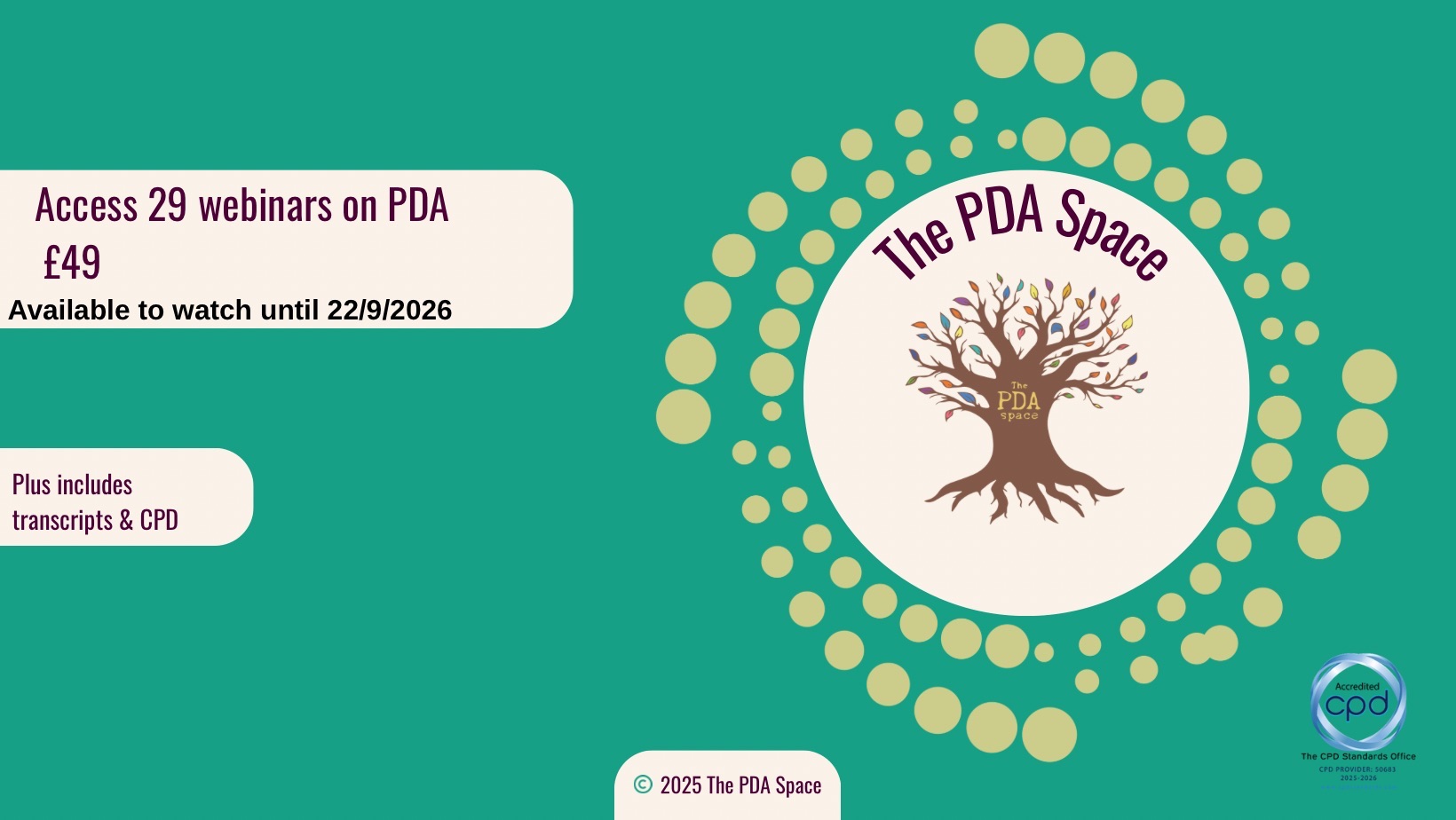
You can access all 29 webinars including transcripts and CPD included for £49
Buy your pass for just £49Free E-book Download
Download the programme to read more about what's included
Click below to download your copy
Get access to all 29 webinars
The Back Pocket Pass gives you access to all 29 webinars, so you can come back to the sessions that resonate, at a pace that works for you.
Rather than trying to take everything in at once, you can dip in and out, revisit key moments, and return to what you need, when you need it until 22 September 2026.
You’ll also receive transcripts and CPD hours.
Was £124, now £49
Buy 5 Staff Passes
CPD Focus and Learning Outcomes
The Professionals' Pack supports staff to:
⭐️Understanding PDA and neurodivergence in education
⭐️Recognising and responding to neurodivergent distress
⭐️Reframing behaviour as communication and nervous system stress
⭐️Reducing escalation through lower-demand approaches
⭐️Supporting inclusion, equity, and access to learning
The emphasis is on practical application, staff confidence, and consistent approaches across teams and whole school approach.
Buy it now below or email admin@thepdaspace.com for a purchase order
The Back Pocket Pass gives you the ability to rewatch the webinars until 23rd September 2026, taking your time to complete the CPD quiz.
Free E-book Download
Download the programme to read more about what's included
Click below to download your copy
Meet your speakers

In this webinar, Amanda, the founder of Neurodiverse Adventures, discusses the importance of reframing disability as a social construct rather than a personal or medical issue.
She emphasizes the need for society to shift its perspective on disability and promote access and inclusion. Amanda shares her personal experiences as a neurodivergent individual and her dedication to supporting the neurodivergent community through her organization's workshops, coaching, and community spaces.

Diane Gould, founder and executive director of PDA North America, talks about equity for all students. It is what we all deserve. She explains the situation for students in America, which is even more dire than the situation in the UK.
Diane explains that PDA North America is about to launch a training program for schools, which they hope will be helpful. She explains what students need to be successful at school, which is not particularly difficult to achieve. Diane also believes that everyone benefits when students have their needs met at school.

In this webinar, Nicola and H discuss various personal and professional challenges, including medical appointments, client management, and experiences with online harassment and misgendering.
They explore topics related to intersectionality, identity, and the complexities of living with disabilities, with H sharing their experiences as a trans and queer individual in education.
They also discuss advocacy, cultural differences in perspectives, and concerns about social media behaviour, while emphasizing the importance of understanding and supporting marginalized individuals across different communities.

Research tells us that it isn’t just demand avoidance that gets in the way of task completion for most PDAers. Executive functioning difficulties have a big impact too.
This webinar will inform you of what executive functioning skills are, how to spot difficulties in this area, and how to support executive functioning skills in PDA-affirming ways.

Using language for equalising behaviours in PDA
In this webinar, Libby will look at what equalising behaviours are, the different types, and how PDA-ers use language as part of this.
Libby has been noting examples for the past ten years and she will look at why they do this and how to respond.

In this workshop, explore what equity means for neurodivergent people through the lens of sensory processing, autonomy, and the environment. Together, we identify the barriers that create sensory inequity and examine how shifting sensory capacity and power imbalances impact access to learning, play, and safety.
You'll gain practical sensory strategies and accommodations to support children's nervous systems, respond to their fluctuating capacity, and honour their inner knowing by reshaping environments rather than reshaping children.
This session is for parents, educators, and professionals who want to create sensory-responsive, low-demand spaces that provide sensory equity.

In this animated presentation, Sally Cat discusses the difficulties faced by PDA adults in living happy and successful lives, and how these challenges can be addressed.
She presents a three-tier framework for getting past the barriers created by our own PDA brains.
The first tier involves using a variety of tips and tricks to outwit demand avoidance at a basic level. These include strategies such as tiptoeing, prioritising, and plate-spinning.
The second tier is about accepting who we are, including limits that may not match those of society or our own expectations. This can improve self-esteem and make it easier to set achievable goals. Sally gives the example of a night owl avoiding commitments with early starts.
The third tier covers possible workplace accommodations that could make employment more endurable for PDA individuals.

This webinar is for any one who cares for, works with or supports PDA children, young people or adults
This webinar will look at PDA, what it is and how it can feel. We will also touch upon what happens if PDA isn’t recognised in your locality.
Finally, we will give a brief introduction to the PANDA strategies, which aim make life easier for PDA people and those who care for, work with or support them.
The essence of this webinar is raising awareness of this profile of autism, how it differs from other autism profiles and how we can adapt strategies to make life easier for PDA people

Equity, Not Equality: Rethinking Support for Neurodivergent Lives
Nicola explores why equity must sit at the heart of support in education, workplaces, and home life. She highlights the flaws of one-size-fits-all “strategies” and the need to meet people where they are, with flexible, scaffolded support that adapts to changing needs.
This session also looks at how schools can build whole-community understanding of neurodivergence, moving beyond kindness toward genuine equity that honours lived experience.

In this webinar, Matt, co-founder of Comfa, shares his journey as a neurodivergent business owner, highlighting the challenges and strengths he encounters while setting up and running a business.
Matt discusses his background, including his training as an actor, master's in marketing, and his experience as a restaurant manager before the COVID-19 pandemic led to his redundancy.
Free E-book Download
Download the programme to read more about what's included
Click below to download your copy
Buy an individual pass
The Back Pocket Pass gives you the ability to rewatch the webinars until 23rd September 2026
You will also get transcripts and CPD hours credited.
Was £124, now just £49
Buy 5 Staff Passes
The Back Pocket Pass gives you the ability to rewatch the webinars until 23rd September 2026, taking your time to complete the CPD quiz.
Get a purchase order
Click the button below to email us, and get a purchase order for 5 passes for your staff.
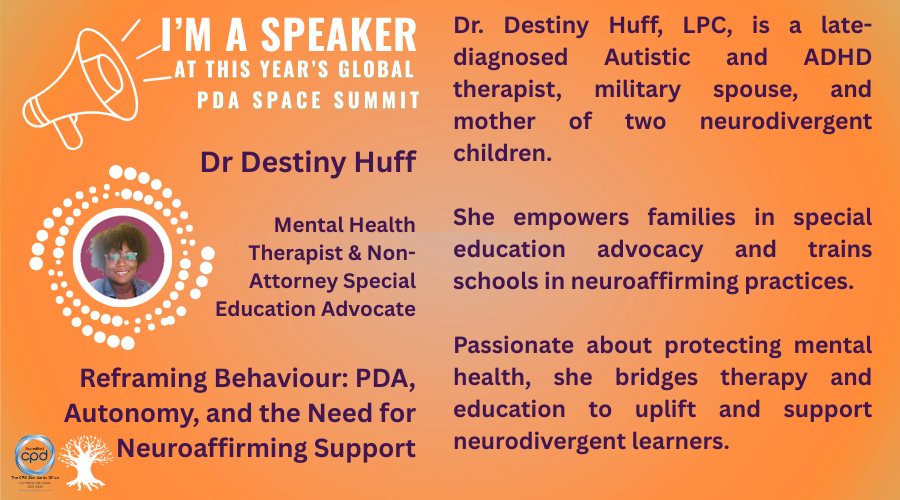
This 40-minute presentation explores PDA through a neuroaffirming lens, challenging traditional behavioural models and reframing what we often mislabel as defiance, noncompliance, or refusal.
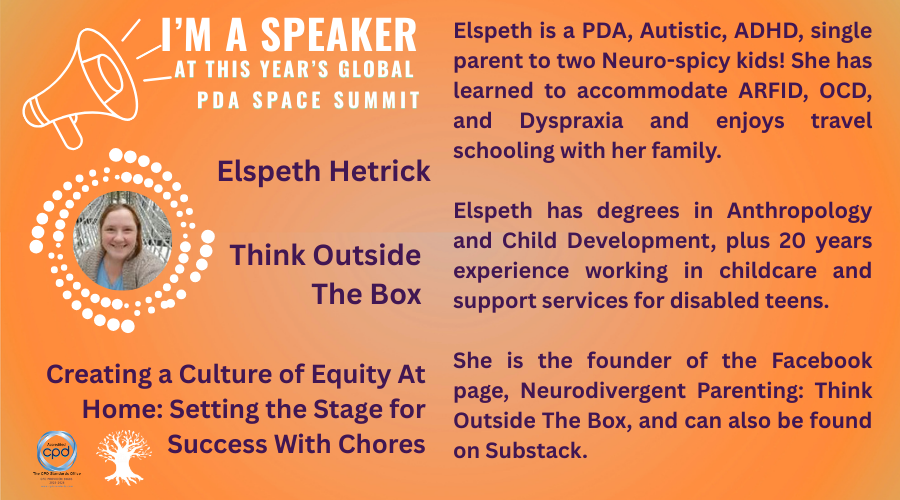
In this webinar, Elspeth explores the unique challenges faced by PDA (Pathological Demand Avoidance) autistic children in completing daily tasks, highlighting the impact of sensory sensitivities, motor skills, and cognitive limitations.
She stresses the importance of caregivers adjusting their expectations and recognising PDA as a disabling condition that often delays the development of self-care and household skills.
Elspeth suggests focusing on familiar tasks, working alongside the child as a team, and offering kind gestures while they are in their own space.

In this webinar, Helen shares her experience as a mixed-heritage neurodivergent individual, citing research on the importance of belonging and the impact of identity rejection on marginalised communities. She explores how schools, families and society can foster equitable identity support and promote a strong sense of belonging.
This webinar helps attendees recognise the significance of naming and addressing identity rejection, its effects on an individual’s nervous system and sense of self, and equitable practices to mitigate it, fostering a stronger sense of identity and belonging.
Parents, teachers, and professionals will understand identity rejection as an external source of dysregulation that can be countered through equitable practices.

This session explores how equity for PDA children must begin in the body, with access to safety, not expectations. Nervous system regulation is a vital yet often overlooked access need, especially for children whose distress is frequently misinterpreted as defiance or avoidance.
Rather than focusing on behaviour, this session reframes participation through the lens of embodied safety. With practical examples and grounded neuroscience, it highlights how co-regulation, sensory scaffolding, and relational support enable meaningful access, so children can engage, connect, and belong on their own terms.

PDA in the Netherlands, spoken in the Dutch language, delivered by Izzy Moneypenny & Myneke ter Maat (http://Ploeteren.nl )
PDA in Nederland, presentatie in het Nederlands door Izzy Moneypenny & Myneke ter Maat (http://Ploeteren.nl ))
A talk about PDA in the Netherlands, some background to the start of support networks and resources available in the Dutch language. We are joined by Myneke ter Maat who tells us about her work with http://Ploeteren.nl and we talk about tips to avoid obligatory involvement of (social) services.

All counselling is political. It either upholds neuronormativity or challenges the idea that there are correct ways to feel emotions, process experiences, and function in this world.
This webinar explores what neurodiversity-affirming counselling entails and how equitable practices can create authentic, empowering spaces.
You'll learn what to look out for when seeking support for yourself or your child, and how to avoid neurodiversity-lite practitioners who co-opt affirming language while working through a pathologising or ableist lens.

Hygiene is often framed as a matter of compliance or social acceptability. But what happens when we approach it as a matter of equity?
For many neurodivergent young people, expectations and approaches around hygiene can become flashpoints for shame, power struggles and losses of control.
This session explores how hygiene intersects with bodily autonomy, sensory experience and identity-expression. We’ll look at compassionate strategies for families, educators and professionals to build equitable hygiene support. Hygiene supports that honour each young person’s dignity.

I wish to help people understand the depth demands go to and how everyday life affects PDAers.
Understanding what demands truly are and their impact on us is crucial. There are demands that most people usually adhere to, but PDAers find difficult to meet.
These include self-imposed demands and those our bodies place on us, which our brains resist.
It's often assumed by non-PDAers that demands are only imposed by others, yet in reality, our brains perceive almost everything in life as a demand. While non-PDAers comply with these demands automatically and effortlessly, PDAers are unable to do so.

In this webinar, Nicola and Mati discuss the concept of internalized ableism, focusing on how autistic individuals often doubt their abilities and question their authenticity due to societal conditioning.
Mati emphasizes the importance of recognizing and challenging ableist attitudes, both external and internal, and highlights the need to trust one's lived experience as a disabled person.
They also touch on the broad spectrum of ableism, including its intersection with other forms of discrimination, and the need for a more inclusive and affirming worldview towards disabled individuals.

Navigating life with chronic illness or other comorbid disabilities with a PDA profile
Giving a lived experience with open honest advice and knowledge for parents and teens dealing with a similar situation
In this webinar, Tracey and Chloe share their lived experiences of navigating life with chronic illness for a PDA teen giving both parent and child perspective with open and honest opinions, tips and guidance on how to regulate and balance demands when dealing with appointments and fatigue.
This webinar will benefit parents, PDA individuals and professionals to help raise understanding, regulating and creating balance whilst navigating life with chronic illness or other co-occurring disabilities.
Free E-book Download
Download the programme to read more about what's included
Click below to download your copy
Buy an individual pass
The Back Pocket Pass gives you the ability to rewatch the webinars until 23rd September 2026
You will also get transcripts and CPD hours credited.
Was £124, now just £49
Buy 5 Staff Passes
The Back Pocket Pass gives you the ability to rewatch the webinars until 23rd September 2026, taking your time to complete the CPD quiz.
Get a purchase order
Click the button below to email us, and get a purchase order for 5 passes for your staff.

Amanda Hind explores the intersection of autism and ethnicity, highlighting how cultural bias, systemic racism, and stereotypes contribute to widespread misdiagnosis and inequity.
Drawing on her lived experience as a late-diagnosed autistic, Black mixed-heritage woman, educator, parent, and researcher, she explains how overlapping marginalized identities amplify barriers in education, healthcare, and society.
Amanda emphasizes the urgent need for better cultural understanding, representation, and neuroaffirming practice, while sharing insights from her PhD research into the school experiences of Black and Black mixed autistic women and girls.
She encourages active listening, advocacy, and embracing strengths to create genuine equity.

In this webinar, Asher shares how her understanding of PDA has changed as she has grown into adulthood.
She describes PDA as a constant battle between what you want to do and what your brain can do and how understanding what your brain can do, enables you to develop strategies to manage how PDA and the demand avoidance challenge, affects your life.

How we can facilitate developing young PDA people’s self-understanding and how that can help create more equitable arrangements around them and all of the associated benefits.
We will be focussing on why we develop self-understanding, what that looks like and what impact that can have and how things like this can help.

This talk challenges the traditional compliance-based education model and demonstrates how trauma-informed approaches create genuine equity for PDAers.
Laura argues that for PDAers, whose nervous systems are constantly scanning for control and safety, trauma-informed education isn't a luxury but an essential requirement for accessing learning.
Through real case studies and practical strategies, she shows how what we often label as 'behaviour problems' are actually trauma responses from nervous systems in distress when faced with demand-heavy, compliance-focused environments.
Laura Linklater, founder of The Motivated Learner (the UK's first trauma-informed tutoring agency), gives parents and professionals permission to buck societal conventions and prioritise their children's wellbeing over conformity.
Attendees will leave with practical tools, expanded understanding of educational trauma, and the confidence to advocate differently for PDAers who need adults willing to work with their neurology rather than against it.

Ideal for parents, carers, and professionals, this session highlights the often-overlooked needs of those raising PDA children and why supporting the parent is key to supporting the whole family.
A focused, honest look at how supporting parent wellbeing in PDA families is not optional, it’s essential.
Join Liz (The Untypical OT), occupational therapist and parent, for a compassionate, low-demand, practical session exploring the often-overlooked needs of parents in PDA families. Grounded in real life and using the person–environment–occupation model, Liz brings a unique OT lens to the emotional and sensory cost of parenting. You’ll leave with practical, sustainable strategies to support your wellbeing—without pretending that “just take a break” is the answer.

Hello everyone, I'm Dr. Natasha Holden - Clinical Psychologist specialising in developmental trauma and parent of PDA children. I'm delighted to join this summit focusing on equity.
In the webinar I will explore why traditional educational approaches fail PDA children and what genuine equity actually looks like. I'm bringing both professional expertise and lived experience to examine the gap between what we know works and what our education system typically provides.
We'll look at the current reality, understand why change is needed from a neuroscientific perspective, and explore practical strategies for creating educational environments where PDA children can truly thrive.
This conversation is about both understanding challenges and finding hope - because transformation is possible when we work with rather than against neurodivergent development.

Equity in Action: Equity for Families, Equity for Professionals
This talk explores how living alongside PDA children challenges us to rethink long-held beliefs, parenting norms, and societal expectations. Our PDAers don’t automatically grant respect, we earn it by meeting them with connection, trust, and understanding. Traditional approaches built on compliance and fear often fuel anxiety; instead, equity means listening, questioning “shoulds,” and finding approaches that truly meet our children where they are.
Nicola shares how respecting autonomy, setting family-specific non-negotiables, and shifting our language opens the door to healthier relationships. She also addresses the realities for parents, the exhaustion, the isolation, and the importance of modelling boundaries and wellbeing. From using simple metaphors to explain capacity, to reframing rules and offering facts, Nicola shows how equity in action is both practical and transformative.
This session invites families and professionals alike to recognise that equity is not about treating everyone the same, but about adapting with compassion, creating space for autonomy, and fostering connection in ways that honour both our children and ourselves.

ARFID isn’t fussiness or bad parenting — it’s a serious eating disorder.
In this webinar, Penny Chapman shares powerful lived and professional insight into ARFID’s pathways, diagnostic barriers, financial strain, and the toll it takes on families. Together, we’ll challenge stigma, confront parental blame, and explore how true equity and compassion can transform support.

Picture yourself in the middle of a circle. Inside the circle is everything that feels safe or fine to your body. Outside the circle is everything that feels threatening.
In this presentation, Rabbi Shoshana will introduce her extended metaphor of a safe circle which forms the foundation of a strengths-based approach to PDA that is decreasing distress and increasing thriving for PDAers of all ages. Viewers of all neurotypes will walk away with deeper self-understanding, increased empathy for a PDAer in their life, and a new tool to support burnout recovery and design a life that works for PDAers across the lifespan.

This webinar is for any one who cares for, works with or supports PDA children, young people or adults
This webinar will look at PDA, what it is and how it can feel. We will also touch upon what happens if PDA isn’t recognised in your locality.
Finally, we will give a brief introduction to the PANDA strategies, which aim make life easier for PDA people and those who care for, work with or support them.
The essence of this webinar is raising awareness of this profile of autism, how it differs from other autism profiles and how we can adapt strategies to make life easier for PDA people
Free E-book Download
Download the programme to read more about what's included
Click below to download your copy
Buy an individual pass
The Back Pocket Pass gives you the ability to rewatch the webinars until 23rd September 2026
You will also get transcripts and CPD hours credited.
Was £124, now just £49
Buy 5 Staff Passes
The Back Pocket Pass gives you the ability to rewatch the webinars until 23rd September 2026, taking your time to complete the CPD quiz.
Get a purchase order
Click the button below to email us, and get a purchase order for 5 passes for your staff.
Disclaimer
Please note that we do not endorse any person, organisation or affiliate.
Whilst we consider our speakers to be the voice of the PDA community, the views presented here do not necessarily reflect those of The PDA Space.
We advise you to do your own research and safeguarding checks before using services offered by any of the speakers featured in the PDA Space Summit. The PDA Space cannot be held responsible.
You are responsible for your own due diligence.